A Different Angle on Overdentures
Giving Overdentures a Better Angle on Life
Hi, my name is Wendy, and I love making dentures. I love the concepts, the materials science, and creating a smile from scratch. Dentures are the foundation of treatment planning, for teaching and understanding all the concepts related to full arch restorative. In clinical practice, when all else fails (literally and figuratively), dentures are always an option.
Though dentures may be my favorite procedure, they are not always my patients’ first choice. The literature has consistently shown that two implants placed in the anterior mandible can greatly improve a denture wearer’s quality of life. As more clinicians receive training in implant surgery and more patients become aware of this option, there is a growing demand for implant-supported overdentures.
The Straight Truth About Crooked Implants
In an ideal world (or on social media), implants supporting overdentures are always placed in perfectly parallel positions. In reality, that is not always possible. Anatomic structures, bone availability, patient-specific considerations, and surgical constraints can result in implants that diverge from one another. While minor discrepancies can often be managed, greater angulations may complicate overdenture treatment and affect prosthesis insertion, retention, and long-term maintenance. Have you ever had a retentive insert that wore out very quickly? Or one that would not stay in its housing? Or one attachment that had that satisfying snap while the other just would not snap no matter how much you shimmied?
Maybe the patient had a buccal or lingual concavity. Maybe anatomy limited ideal placement. Maybe you're restoring implants that were placed years ago. Whatever the reason, implant divergence is one of those clinical realities we all run into. For me, these are the cases that have required complex engineering. I would custom design and mill pieces or use a bar to connect the diverging implants. These prostheses took extra chair time and came with much higher laboratory costs.
Designed for Divergence
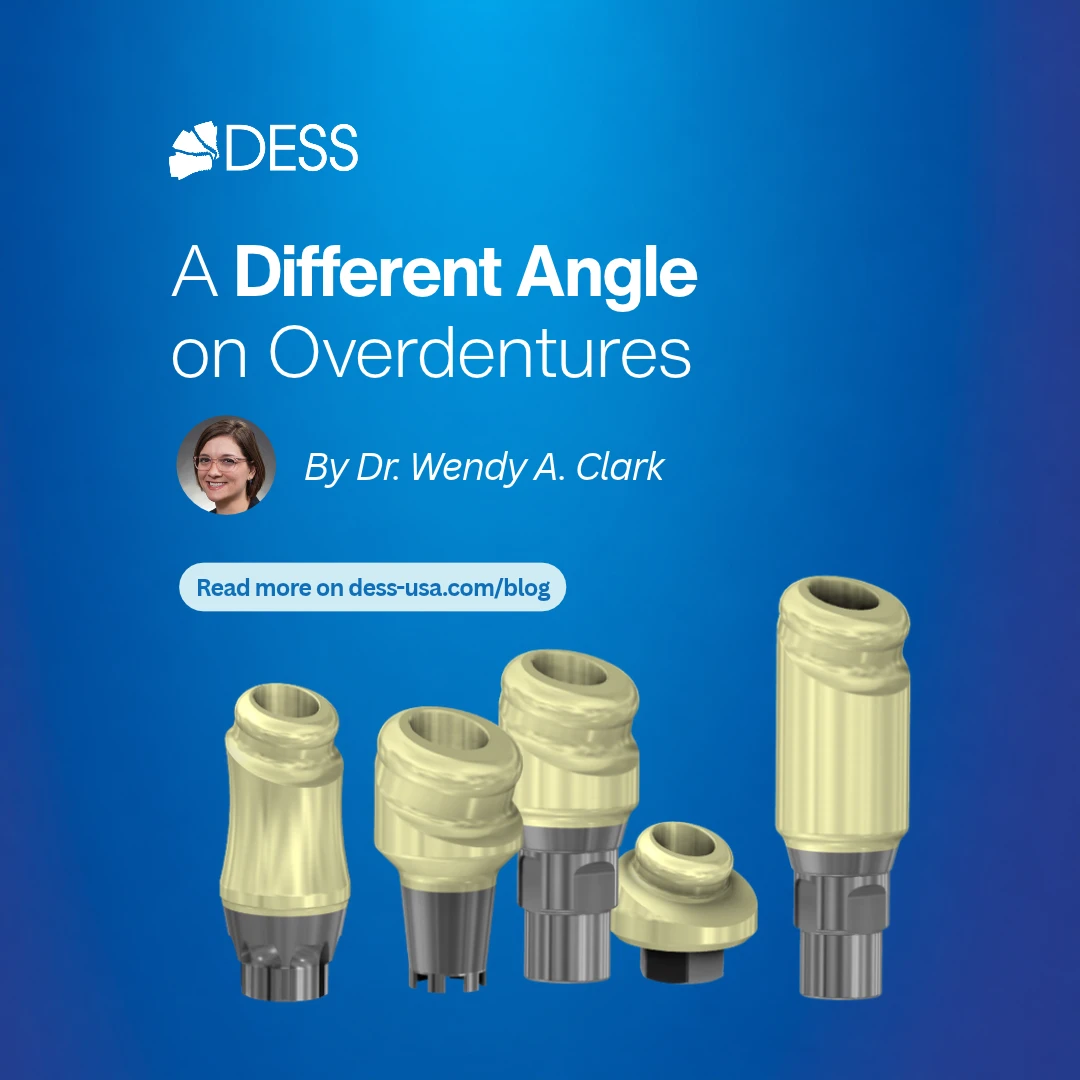
Recognizing this challenge, DESS has expanded its overdenture portfolio with Angled DESSLoc®. This prefabricated angled abutment provides a straightforward restorative solution for implant-supported overdentures involving divergent implants, giving clinicians an additional option for managing challenging cases.
Each abutment features an 18° angle, but the real magic happens when it is combined with the DESSLoc® retention system. When used with DESSLoc® 40° inserts, Angled DESSLoc® can accommodate up to 76° of divergence between two implants.
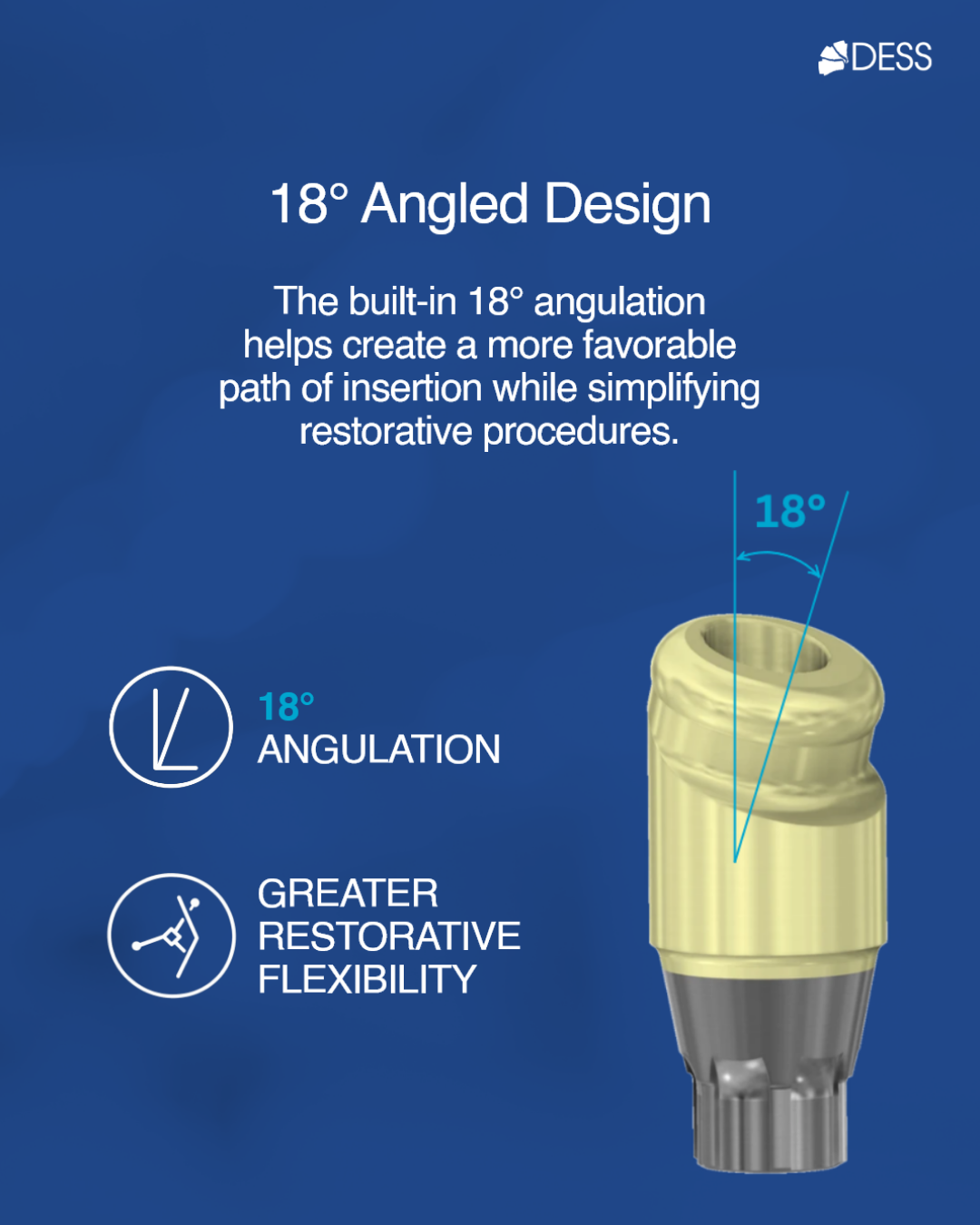
This can mean successfully treating cases that previously may have required customized parts. Instead of designing around implant angulation, we're able to work with it while maintaining a familiar overdenture workflow.
Built on the DESSLoc® Platform
The Angled DESSLoc® is easy to integrate into practice right away. It incorporates the familiar features and protocols of the DESSLoc® system, DESS®'s overdenture solution that clinicians have trusted for years. This means the same predictable retention, ease of use, and cross-compatibility with leading overdenture protocols.
Clinicians who are already familiar with overdenture attachment systems can adopt the Angled DESSLoc® solution without disturbing their typical overdenture protocols. The angled system is designed to be fully compatible all the restorative components used within the DESSLoc® ecosystem (inserts, housings, copings, etc.). This allows clinicians and laboratories to incorporate the angled option without additional inventory. DESSLoc® and Angled DESSLoc® components are available for many implant systems, allowing practices to standardize overdenture treatment protocols across multiple implant brands.
Advanced Surface Technology
Another feature of the DESSLoc® family is their PerioCoat® surface technology. This zirconium nitride (ZrN) coating is incorporated into DESSLoc® abutments, including Angled DESSLoc®. This coating is designed to help reduce plaque accumulation and bacterial biofilm adhesion, making cleaning easier. This has been a great solution for my patients with challenging home hygiene. The surface treatment also provides enhanced wear resistance, helping preserve the integrity of the attachment over time.
Why This Matters
With a few exceptions , most of my patients do not care about degrees of divergence, attachment geometries, or surface coatings. They care about whether their dentures feel secure and whether they can chew comfortably.
One of the things I appreciate about the Angled DESSLoc® is that it helps address a problem that patients often experience without understanding the underlying cause. When implants are not ideally aligned, overdentures can become more difficult to insert and remove, retention components may wear more quickly, and maintenance appointments can become more frequent. By creating a more favorable path of insertion and reducing the need for complicated restorative workarounds, the Angled DESSLoc® helps make life easier for both the clinician and the patient. And those are my favorite innovations: the ones that make treatment simpler while improving the patient experience.
Another Tool in Your Toolbox
As implant overdenture therapy continues to evolve, treatment providers increasingly seek solutions that address both biological and restorative challenges. The Angled DESSLoc® provides another option for addressing these challenges.
With its angulated design, familiar DESSLoc® components, and PerioCoat® surface technology, Angled DESSLoc® offers clinicians a solution designed to simplify treatment while providing greater flexibility in challenging cases.