


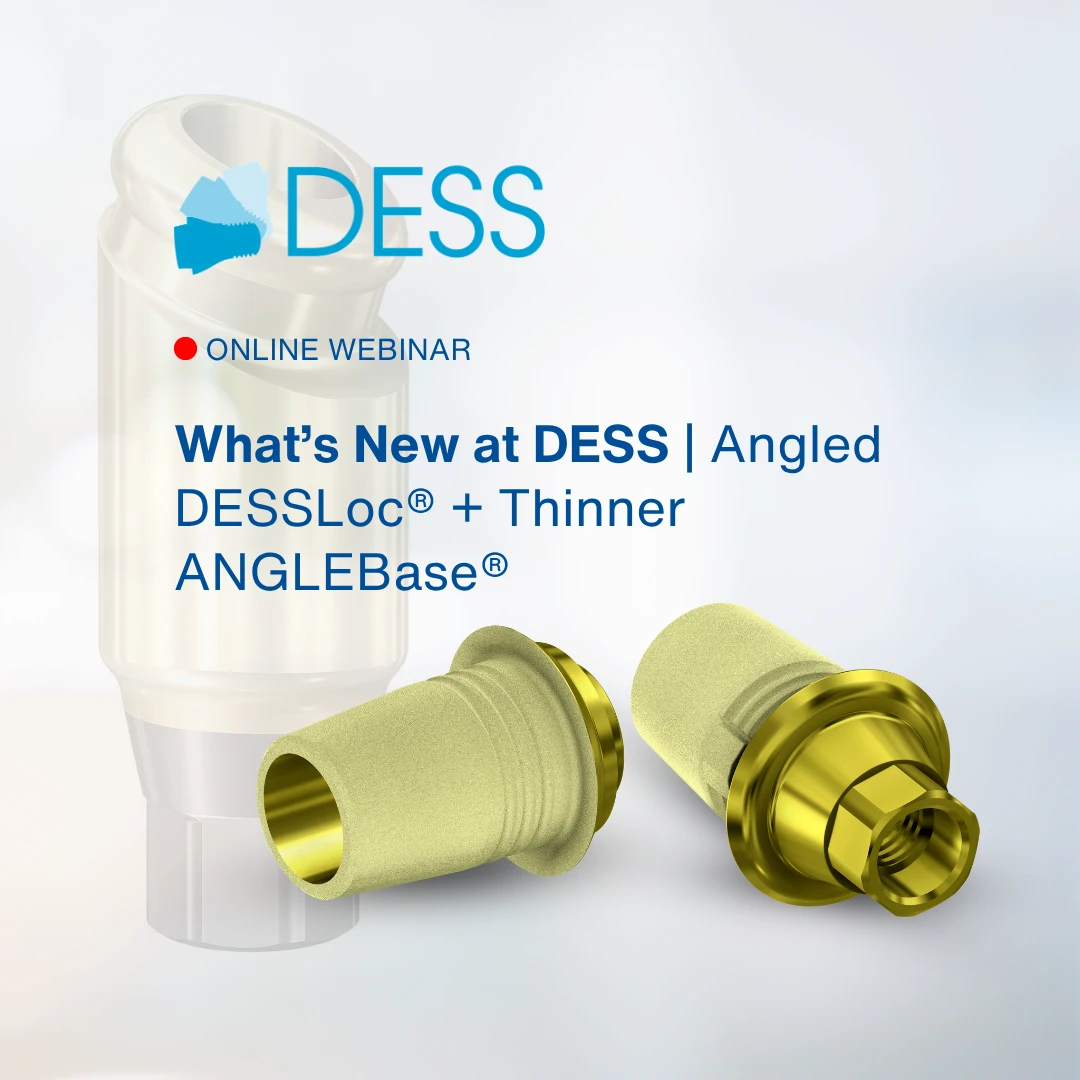
What’s New at DESS® | Angled DESSLoc® + Thinner ANGLEBase®
More Options, More Flexibility: A Look at the Latest Solutions from DESS®
One thing we hear consistently from our customers is that they want more options without adding more complexity to their workflow.
That is something we think about a lot at DESS. New products should solve real problems. They should make it easier to work through challenging cases, give you more flexibility when you need it, and fit into the workflows you are already comfortable using.
That was really the focus of our recent New Products webinar, where we brought together perspectives from the clinical, laboratory, and digital sides of implant dentistry. We took a closer look at two of our latest restorative solutions, Angled DESSLoc® and the Thinner ANGLEBase®, as well as the digital tools and workflows that support them.
Both products address different challenges, but they were developed with a similar idea in mind: provide more restorative options without unnecessarily changing the way you work.
A Thinner Option When Restorative Space Is Limited
The first product we focused on during the webinar was the new Thinner ANGLEBase®.
Our ANGLEBase® has always been about providing flexibility in screw-retained restorations by allowing the screw access channel to be redirected when a straight access channel is not ideal. The Thinner ANGLEBase® takes that concept and gives customers another option for cases where restorative space is more limited.
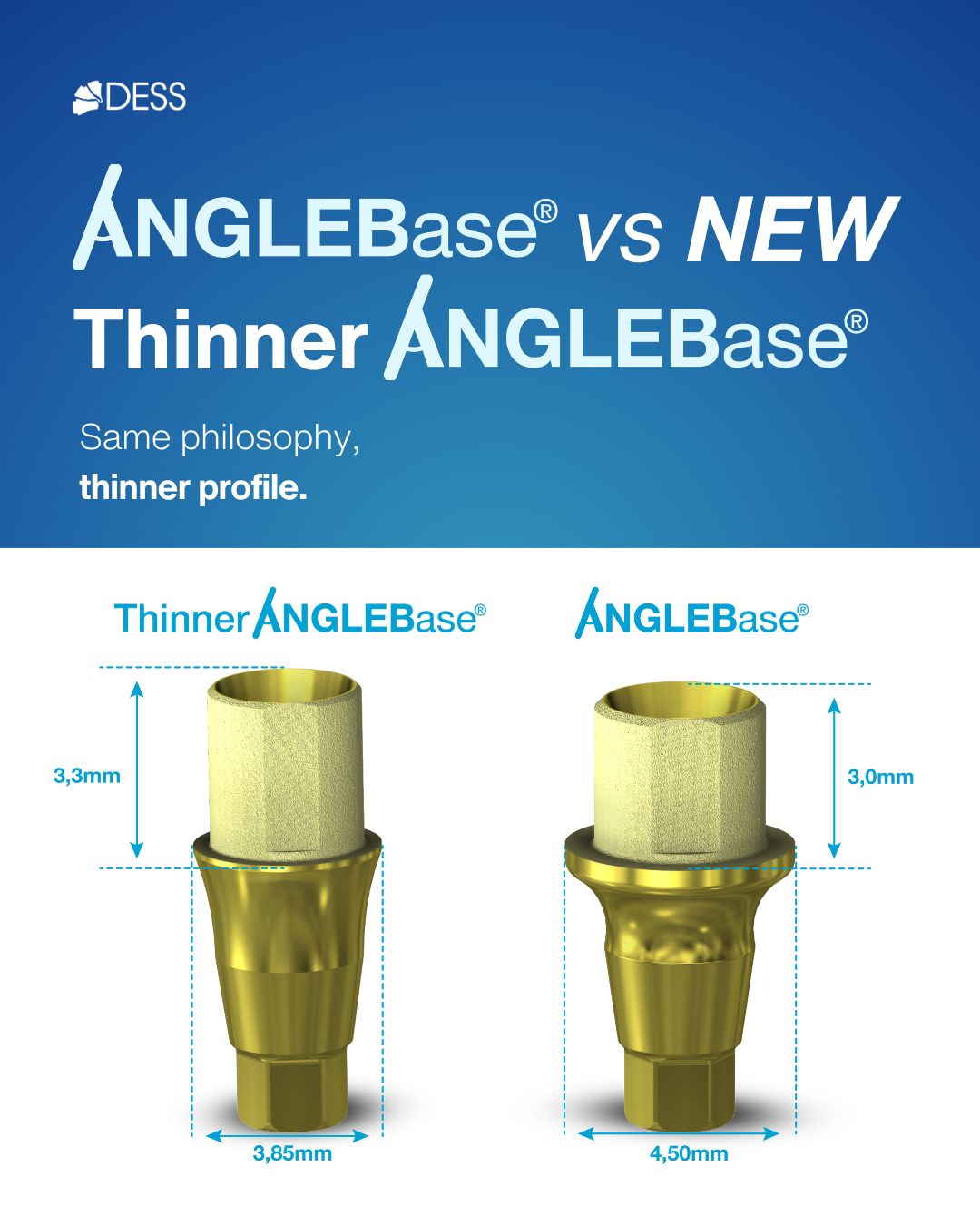
The prosthetic platform has been reduced from 4.5 mm to 3.85 mm, creating a slimmer profile and a more gradual transition from the implant to the restoration. At the same time, the interface height has increased from 3.0 mm to 3.3 mm, providing additional bonding surface.
Those may sound like small dimensional changes, but in a case where space is limited, small changes can make a meaningful difference.
The Thinner ANGLEBase® maintains the flexibility of angled screw access correction, offering up to 25° of correction with 360° rotational freedom. It is available in 0.8 mm and 1.5 mm gingival heights, with a 2.5 mm option also available for Neodent® Grand Morse® compatibility.
It also incorporates our SelectGrip® surface technology, designed to enhance mechanical cement retention, along with a gold-anodized surface.
The result is another option within the ANGLEBase® family for situations where you need both angulation and a narrower restorative profile.
More Flexibility for Challenging Implant Cases
Implant divergence is nothing new, particularly when working with removable restorations. What matters is having options available when ideal implant positioning is not possible.
The Angled DESSLoc® was designed specifically to provide greater flexibility in these situations while maintaining the familiar DESSLoc® workflow.
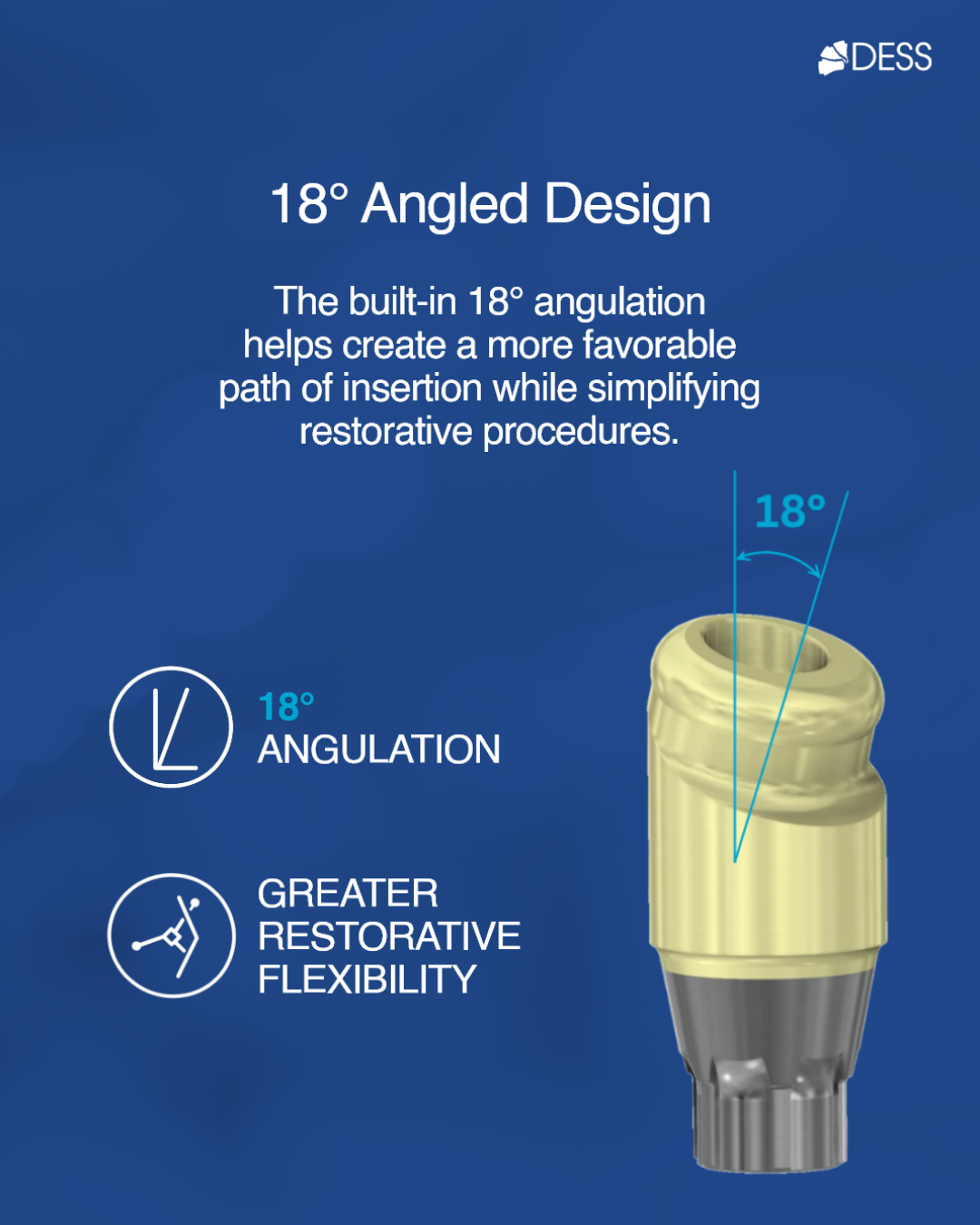
With an 18° angled design, Angled DESSLoc® can accommodate up to 76° of implant divergence between two implants, expanding the restorative possibilities in cases where implant positioning creates additional challenges.
The goal was not to create an entirely different workflow. It was to expand what could be accomplished within one that many customers already know.
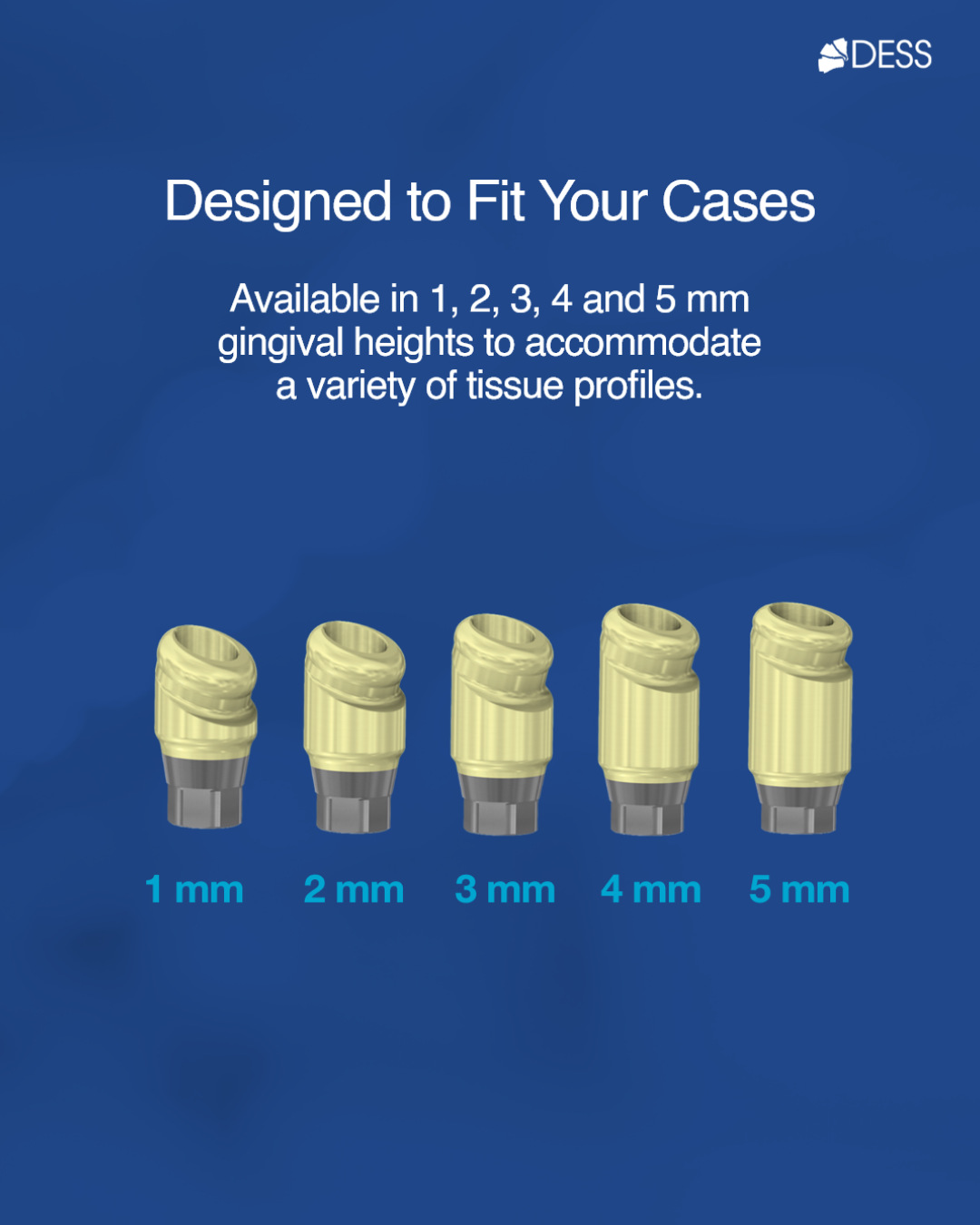
Angled DESSLoc® is available in five gingival heights from 1 mm to 5 mm, providing options for different tissue profiles. It is also designed for use with the red, orange and green 40° extended-range DESSLoc® retention inserts.
For us, that flexibility is important. Every case is different, and the more options you have available to work around implant position, tissue height and restorative requirements, the better equipped you are to find the right solution for the case.
The Product Is Only Part of the Workflow
Of course, today we cannot talk about restorative components without talking about the digital workflow that surrounds them.
Having the right physical component is important, but that component also has to work within the design and manufacturing process. That is why digital libraries continue to be such an important part of what we do at DESS.
DESS provides downloadable libraries and supporting resources for major dental CAD platforms, including 3Shape and exocad, with dedicated ANGLEBase® libraries and step-by-step resources available through the DESS USA library page.
That connection between the physical component and the digital workflow is critical. When you are designing a restoration, the software needs the correct component information so that what is being designed digitally corresponds with what will ultimately be used in the final restoration.
It is also why we continue to invest in digital support and education. Our goal is not simply to provide a component and leave customers to figure out the rest. We want the supporting tools, libraries and resources to be there as well.
Continuing to Solve Everyday Restorative Challenges
The conversation during our New Products webinar reinforced something we see every day: there is rarely one solution that works for every case.
Sometimes the challenge is implant divergence. Sometimes it is limited restorative space. Sometimes it is screw access, tissue height or making sure the digital workflow supports the component you want to use.
The role we want DESS to play is to give customers more ways to solve those challenges.
Angled DESSLoc® and the Thinner ANGLEBase® are two examples of that approach. Neither requires reinventing an entire workflow. Instead, they expand the options available within familiar restorative workflows so that when a more challenging case comes along, there is another solution available.
And that is ultimately what product development should do: give you more flexibility to find the right solution for the case in front of you.